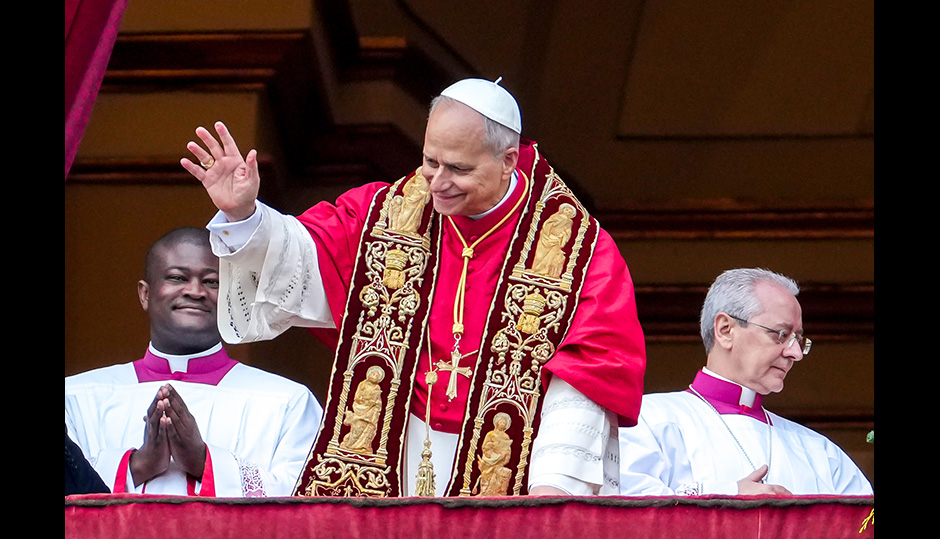
VATICAN CITY — One year after stepping onto the central balcony of St. Peter’s Basilica and greeting the world with the words, “May peace be with you all,” Pope Leo XIV has emerged as a pontiff attempting to guide a polarized church and fractured world through dialogue, peace and increasingly forceful speech defending human dignity.
His first year of the papacy has been marked with palpable tensions around the globe and persistent divisions within the church — challenges many cardinals believed he was uniquely positioned to confront when they elected him to continue Pope Francis’ broader vision.
Beyond the Vatican, members of U.S. President Donald J. Trump’s administration have frequently criticized the first American pope as “weak” on crime and dismissed his warnings about war and nuclear escalation after the pope reiterated that “God does not bless any conflict.”
Yet through it all, Pope Leo has remained remarkably consistent and steadfast in tone and message, repeatedly returning to peace, dialogue and reconciliation as hallmarks of his papacy.
One of the electors in last year’s conclave, U.S. Cardinal Robert W. McElroy of Washington, D.C., told the audience during an April 28 event at Villanova University that Pope Leo united clergy in a way he has never seen before.
“As he has grappled with this question of forward progress or retrenchment, he has done it in an Augustinian way: one in heart and soul and harmony together, by seeking to integrate the different elements within the life of the church.”
On the first anniversary of his election, Pope Leo traveled to Pompeii for celebrations marking the feast of the Supplication to Our Lady of the Rosary, a prayer composed by St. Bartolo Longo, founder of the Shrine of Our Lady of the Rosary in Pompeii, whom the pope canonized last October.
In his homily in Piazza Bartolo Longo, Pope Leo reflected on the anniversary of his election and entrusted his ministry to the protection of the Blessed Virgin. Echoing themes that have defined his first year as pope, he warned that wars continue “to rage in many regions of the world” and called for renewed spiritual commitment to peace.
“Through [Mary’s] intercession,” he said, “may there come from the God of peace an overflowing outpouring of mercy, touching hearts, calming resentment and fratricidal hatred, and enlightening those who bear special responsibilities of government.”
One year into his pontificate, Pope Leo has emerged as a pope shaped deeply by Augustinian ideals of communion and listening, attempting to navigate ideological and geopolitical divisions not through confrontation, but through listening and dialogue. While more reserved in tone than Pope Francis, he has become increasingly direct on issues involving war, migration, economic exploitation and human dignity.
“In a sense, Bob Prevost continues to be Bob Prevost,” said Father Arthur Purcaro, an Augustinian priest and longtime friend of the pope. “But he’s grown in the role of the ministry, which he has assumed.”
He told Catholic News Service May 4 that he had joked with the pope on a phone call, saying that he was surprised at his friend’s ability to be more gregarious, waving and greeting crowds of thousands of people.
“He said, ‘I know it, but it comes from within,’” Purcaro said. “So it’s something that God has called out of him.”
Purcaro said the pope has always been “a man of prayer, a listener first and foremost,” qualities that continue to shape how he governs.
“The nature of the beast — Bob Prevost is now Leo — is not to divide, but to unite,” he said in a video call with CNS.
That emphasis on unity has become one of the defining themes of Pope Leo’s first year. Before his election, then-Cardinal Prevost repeatedly warned about ideological division inside the church.
“The lack of unity is a wound that the church suffers, a very painful one,” he said in a 2023 interview. “Divisions and polemics in the church do not help anything.”
The conclave that elected Pope Leo on May 8, 2025, was the largest and among the most geographically diverse in history. Then-Cardinal Prevost, a Chicago native who spent decades serving as an Augustinian missionary and bishop in Peru before leading the Vatican Dicastery for Bishops, was seen by many cardinals as someone capable of continuing Pope Francis’ reforms while lowering tensions within the church.
“They voted for him because he was going to follow through on Francis’ commitment, but to do it in a different way,” Purcaro said.
For much of his first year, Pope Leo’s calendar was shaped by commitments inherited from Pope Francis, including the 2025 Jubilee Year of Hope and the planned trip to Turkey and Lebanon. But after the jubilee concluded, the pope began moving more decisively to lead the church according to his unique vision.
Vatican Secretary of State Cardinal Pietro Parolin said the pope has shown that synodality — the church’s emphasis on communal discernment and shared responsibility — is his “first and foremost” style of governance.
“Listening is an act of great ecclesial significance,” he said in a talk March 18 in Rome. “That the pope makes himself available to listen is a great lesson for everyone.”
Drawing on his Augustinian spirituality, Pope Leo has repeatedly stressed that truth emerges through listening to many — even divergent — perspectives rather than debate or conflict.
“He has highlighted the need for ongoing conversation, and that truth does not come from one individual, but rather through dialogue among many,” theologian Jaisy Joseph said during the April 28 lecture at Villanova University, which was also livestreamed.
Joseph said Pope Leo has presented synodality “as an antidote to the deep polarizations of our times.”
Debates over liturgy and authority continue to divide some Catholics, including the traditionalist Society of St. Pius X’s announced plans to consecrate new bishops July 1, following years of tension. While tensions remain between traditionalists who hold objections to certain church teachings, particularly those of the Second Vatican Council, and Catholics who would like to see even further reforms, those close to the pope say he has always had the ability to make people across ideological lines feel genuinely heard.
“He’ll listen to somebody before he’ll say, ‘Yeah, I can see what you’re saying, and I hear you and I recognize what you’re pointing out as a need. I hope you can also see the need that I’m trying to present to you on the other side of the coin,’” Purcaro said.
Pope Leo’s background has also shaped the global perspective of his papacy. Before becoming pope, he spent about 20 years in each in three parts of the world: the United States, Peru and Rome, becoming a Peruvian citizen during his years serving in Chiclayo.
His missionary experience has remained central to his priorities, particularly on migration.
Father John Lydon, an Augustinian priest who worked alongside then-Bishop Prevost in Peru, recalled how the future pope publicly defended human rights during Peru’s authoritarian period in the 1990s and later organized support programs like soup kitchens and temporary housing for Venezuelan migrants arriving in Chiclayo.
“He’s not going to bend, because the moral compass is clear,” Lydon said at the April 28 event at Villanova University. “Migration has always been an issue close to Pope Leo’s heart.”
Thus far, he has made it clear that his priorities for the church lie with justice, human dignity and peace. On the flight back from Africa to Rome in April, the pope told reporters that “unity or division of the church should not revolve around sexual matters,” saying “there are much greater and more important issues, such as justice, equality, freedom of men and women, freedom of religion, that would all take priority before that particular issue.”
This insistence on justice and charity has increasingly shaped Pope Leo’s language on global affairs.
During an 11-day trip across Algeria, Cameroon, Angola and Equatorial Guinea last month, the pope delivered some of the strongest speeches of his pontificate so far, condemning war, corruption, authoritarianism and economic exploitation, marking what Purcaro described as the actual “beginning of his papacy.”
“The masters of war pretend not to know that it takes only a moment to destroy, yet often a lifetime is not enough to rebuild,” the pope said during a peace gathering April 16 in Bamenda, Cameroon.
In Angola, he criticized economic systems that prioritize profit over human dignity.
“How much suffering, how many deaths, how many social and environmental disasters are brought about by this logic of extractivism!” he told political leaders and diplomats April 18.
Cardinal McElroy said the pope has become increasingly comfortable exercising a moral voice on the world stage as his papacy has progressed.
“There is no prophetic moral voice in the world at this time, other than Pope Leo’s,” he said.
Still, those close to Pope Leo say his leadership style is unlikely to become more combative or ideological. Purcaro said the pope prefers nuance over commands and sees dialogue itself as part of the church’s mission.
“So when people listen to Pope Leo hoping he’s got the definitive word on what is to be done, they’re looking for something that’s not there,” he told CNS. “The process is the goal. It’s listening to one another, respecting one another, being aware that everybody has something to offer.”
Purcaro said he expects Pope Leo to publish his own version of “Rerum Novarum” soon, following in the footsteps of Pope Leo XIII, whose encyclical, “Rerum Novarum,” is considered the foundational document for the church’s social teaching. The document from 1891 emphasizes the dignity of workers and condemns the dangers of unchecked capitalism and socialism.
In the Vatican and on the global stage, Purcaro said no one should expect to get explicit instructions or commands from the pope, because he has never been that way. He prefers to lead with nuance, with an Augustinian compass.
“He’s slowly winning people over or challenging them to grow,” he said. “ I think we have a long way to go to see how he will be able to, with the help of the Spirit, obviously, shape the church to respond to the needs of our times.”