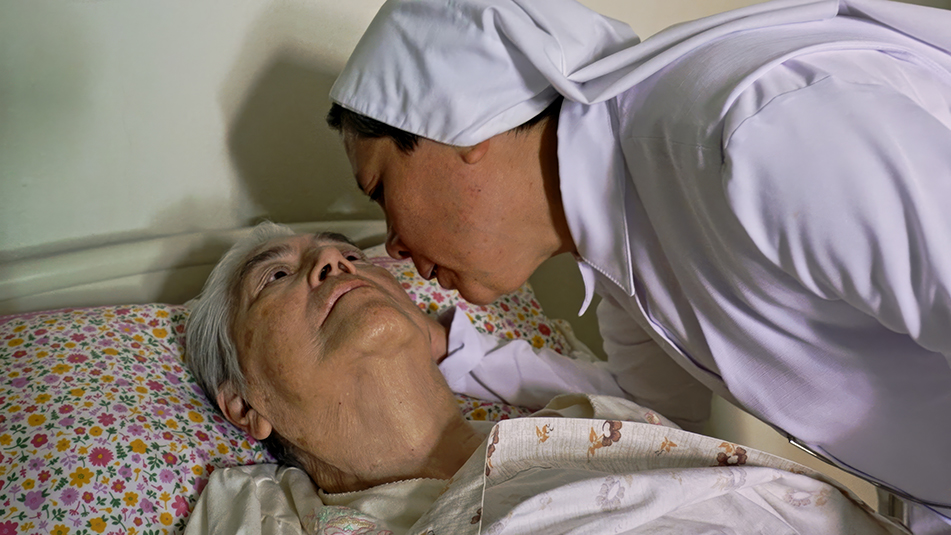
When Linda Corley was growing up in suburban Catholic schools, she never considered who took care of religious sisters when they were too old or infirm to work.
“I never knew what became of older sisters,” said Corley, creator and director of “Walking My Sister Home,” a television documentary that will air Nov. 20 at 3 p.m. on WTTW Prime. “I think we assumed the Vatican took care of them or something.”
According to the Center for Applied Research in the Apostolate, the median age of religious sisters in the United States is about 80 years, and about 1% of religious sisters are 40 or younger.
Corley, who attended St. Philip the Apostle School in Northfield and Regina Dominican High School in Wilmette, said she began thinking about the issue more than a decade ago, after speaking with Sister M. Peter Lillian di Maria, a Carmelite of the Aged and Infirm.
She met Sister Peter while producing the Lifetime series “The Sisterhood: Becoming a Nun,” and the two became friends. Sister Peter leads the Avila Institute of Gerontology, her community’s education arm, and she suggested there was a story for Corley to explore about how communities around the world care for their aging sisters.
Corley received a grant from the Conrad N. Hilton Foundation to pursue the project, which was to premiere on WORLD Channel Nov. 8 and begin streaming on PBS.org in November.
The documentary includes visits with women’s religious communities in Kenya and Zambia and Mexico, as well as the Franciscan Sisters of Tiffin, Ohio.
Corley said she chose the Tiffin Franciscans because of their typical American story: Founded in the years after the Civil War, one of the sisters’ first ministries was caring for children who were sent west on “orphan trains.”
Now, with their membership both aging and shrinking in numbers, the sisters are grappling with how to care for one another while they discern what will happen to the community. While they have not committed to allowing their community to come to “completion,” it seems likely that they will have to make that decision in the coming years, and they have already decided that, if and when that time comes, their buildings and property should be used to house people who are homeless.
“That’s a story that’s very typical of the American sister right now,” Corley said. “What it says is that they are having to face the end of a wonderful era, and it’s very sad for them.”
The congregations Corley visited in Africa have more younger members who are able to care for their older sisters, she said, but many of them are living without adequate financial resources, and without the education they need to provide proper care.
That’s one thing the Avila Institute of Gerontology can help with, bringing sisters from around the world to learn more about how to care for aging people, especially those suffering from dementia and other effects of age.
As a filmmaker, Corley said, showing the way the sisters live in Africa was a challenge because they treated her and her crew like honored guests, rather than sharing the difficulties they face.
“Sisters don’t complain,” she said. “In the early days of being there for three weeks, I struggled there to get them to show me the harshness, show me the sisters who are scavenging for fresh water. They’d say, ‘Do you really want to see that?’”
The sisters she visited in Mexico were suffering most from a lack of money, she said, recalling one elderly sister who was dying from breast cancer. Her congregation could not afford chemotherapy.
“It was the sadness that I saw,” she said, “and not having the wherewithal to help.”
Most Catholics she speaks to about the film have two things to say. The first, Corley said, is that they never knew about the unmet needs of senior sisters. The second is to ask how they can help.
To address that question, producers created a website, walkingmysisterhome.com, with information about the film and the congregations it features, as well places to donate money.
Catholics in the United States can also donate to the Fund for Retired Religious, whose annual collection will be taken up at Masses the weekend of Dec. 12 and 13.
Corley said there are things people can do besides giving money.
“Just something small like going to visit them,” she said. “They just love visitors. They love to talk, and talk about their careers.”