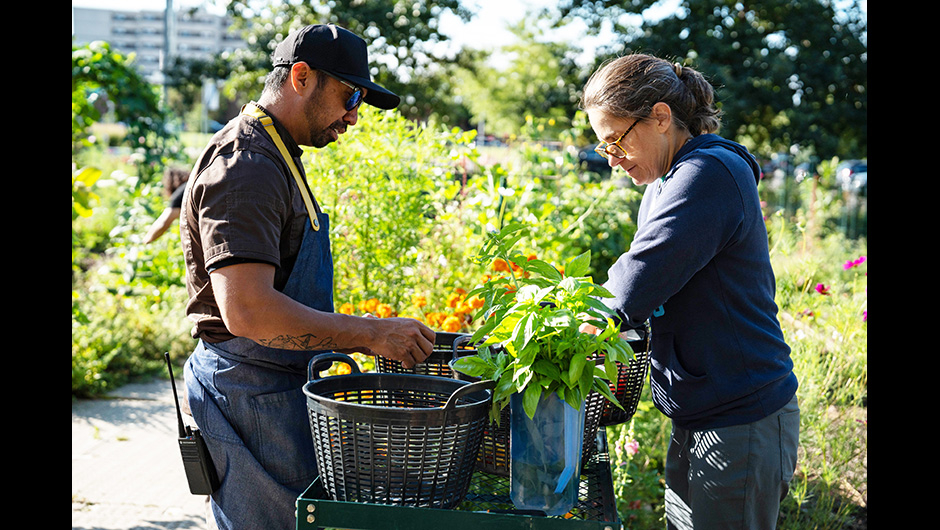
When students at DePaul College Prep get lunch in the school’s dining hall, there’s a good chance that their classmates — or maybe even the students themselves — had a part in growing and harvesting some of the food on their plates.
Quest Food Management Services works with the school to use produce grown in the Wendell and Marie Smith Garden on the DePaul Prep campus, including vegetables, herbs and microgreens, in scratch-made meals.
“As a Catholic school in Chicago whose students all live in Chicago, we really wanted to focus on the importance of sustainable, healthy eating,” said DePaul President Mary Dempsey, who noted that health is one of the school’s core values. “And the importance of service, how what we can do here can be incorporated into our daily food, but also serving the nutritional needs of those who live on the margins of society through food pantry donations.”
The school has about 100 students enrolled in six sections of her sustainable urban food systems and culinary arts class this year, teacher Melissa Flynn said. Students in the class plant, weed, water and harvest produce from the garden and learn to cook what they’ve grown, Flynn said.
“The students are integral to the garden process,” she said.
The class is an elective in the STEAM (science, technology, engineering, arts and math) area.
The class also takes a look at wider themes of sustainability, similar to those highlighted in Pope Francis’ 2015 encyclical “Laudato Si’: On Care for Our Common Home,” Flynn said, with students asked to identify and change a habit that impacts the environment, whether that means, for example, walking or biking to school instead of driving or taking shorter showers.
Flynn and garden manager David Toledo plan what will be planted, Flynn explained, based on what the class will use for its lessons and what the food service program uses most often, including common salad and sandwich ingredients.
The regenerative urban garden grows a variety of seasonal produce, including tomatoes, onions, celery, collard greens, cabbage, potatoes, sweet potatoes, beans, melons, kale, garlic, amaranth and lemon sorrel. The garden also produces herbs like sage, mint, oregano, savory, marjoram, parsley and lemon balm.
Garden-grown produce and garnishes also grace the tables at receptions for donors and other events at the school, Dempsey said.
Vivian Robles, district manager for Quest Food Management Systems, said some of the other schools Quest works with have asked to have some things they’ve produced included in food service, but none of their clients takes the “farm-to-table” concept as far as DePaul Prep does.
“The chef works very closely with them,” Robles said.
Because students sometimes take what they’ve harvested directly to executive chef Romel Alvar, they are very aware that they and their peers will eat what they’ve grown, Flynn said.
Dempsey said the class helps students make connections between their own lives and larger issues with food and environmental systems.
“They really talk with their students about the global impact,” she said. “Our students are in a micro way being educated about the macro world.”
Flynn said students and parents join staff in maintaining the garden during the summer. Much of the produce that is harvested when school is not in session is donated to Nourishing Hope, a not-for-profit that addresses hunger issues in Chicago.
“What we don’t use in class gets used in the dining hall,” she said. “Anything additional goes to the food pantries, and the scraps get composted, and that gets used in the garden. Nothing is wasted.”
Flynn said the goal of the class is for students to notice the world around them and understand how they can affect it, for better or worse, and then to take steps to reduce their environmental impact.
At a more basic level, she wants them to finish the class knowing how to prepare a meal for themselves and appreciating home-grown food.
“Even if it’s a balcony garden or a pot garden,” she said. “We know that students come into the gardens sometimes and say, ‘I don’t like that food. I don’t want to taste it.’ When they pick it themselves, nine times out of 10, they absolutely love it.”