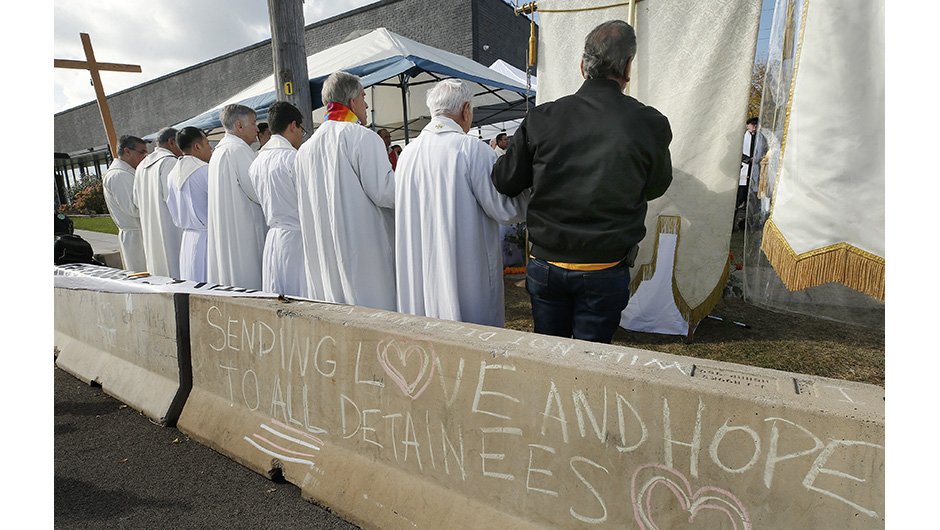
People detained in the U.S. Department of Homeland Security’s Immigration and Customs Enforcement facility in Broadview began receiving daily pastoral care visits on May 15.
The visits were organized under an agreement between the Coalition for Spiritual and Public Leadership and federal officials months after the coalition filed a lawsuit seeking such access.
“This agreement represents a recognition of the human dignity and basic human rights of our detained sisters and brothers,” said CSPL Executive Director Michael N. Okińczyc-Cruz.
CSPL began advocating for such visits nearly 10 months ago, and filed the lawsuit in November after delegations of priests, women and men religious and laypeople were denied entry to the facility to offer Communion and provide pastoral care during an October Eucharistic procession and a Nov. 1 All Saints Day Mass celebrated outside the facility.
Prior to the agreement reached May 14, leaders were allowed into the facility on Ash Wednesday as well as during Holy Week and on Easter Sunday.
Under the agreed protocols, Catholic and interfaith leaders will provide spiritual care once a day. This includes bringing the sacraments and other religious items approved in advance.
Sinsinawa Dominican Sister Christin Tomy, a campus minister at Dominican University in River Forest, is among those who have provided pastoral care at Broadview, both on Easter and since the May agreement went into effect.
“It’s a very privileged opportunity to be able to enter and provide pastoral care to people in such vulnerable moments,” said Sister Christin, a member of CSPL’s council of women religious. “It’s difficult to see your brothers and sisters in dehumanizing conditions. I think that’s absolutely where we are called to be. To me, it’s an essential response to the call of the Gospel.”
Conditions for pastoral care visits have changed even since Easter, Sister Christin said. On her first visit, people who were detained were kept shackled, and some communication had to take place through a doorway, with no privacy.
Since the new agreement was reached, 12 men who were detained and the pastoral care providers were able to gather in one room to pray together and have a Communion service, and those who wanted to could receive the sacrament of reconciliation with some level of privacy on May 17, Sister Christin said.
“Since the settlement has been reached, we have been able to provide care in a way that feels a lot more respectful and dignified, where we’re able to sit with folks and to have music and to pray face to face,” she said. “To me, it feels like a really strong improvement in the cooperation between DHS and this group that’s been fighting for pastoral care.”
The improvement comes as immigration enforcement actions in the Chicago area have become less public, and as the people detained at Broadview seem to mostly be there for a day or less, Sister Christin said. That is in line with how the building has been used for many years.
In the fall, there were reports of people being detained in the building for several days in crowded conditions with insufficient food, inadequate facilities for hygiene and sleeping and, reportedly, no consistent access to medications.
Still, Sister Christin said, detainees told her and other members of the delegation that they had been sent to Broadview from other facilities, including one man who said it was the fourth place he had been held.
Claretian Father Paul Keller, a member of CSPL’s clergy council, was part of the delegation May 15.
“To my mind, it’s emergency room treatment,” he said. “Someone is there right when the trauma has happened to attend to the immediate emotional and spiritual wounds.”
Sister Christin said that praying together helped the detainees find community with one another as well as with their visitors.
“One of the gentlemen that we prayed with, at the end of the time, he said in Spanish, ‘Como volver a vivir,’ it’s like coming back to life,” she said. “I can’t say it any more strongly than that. It was really, it was profound to me, to watch the way that the whole demeanor of this group of men changed.”