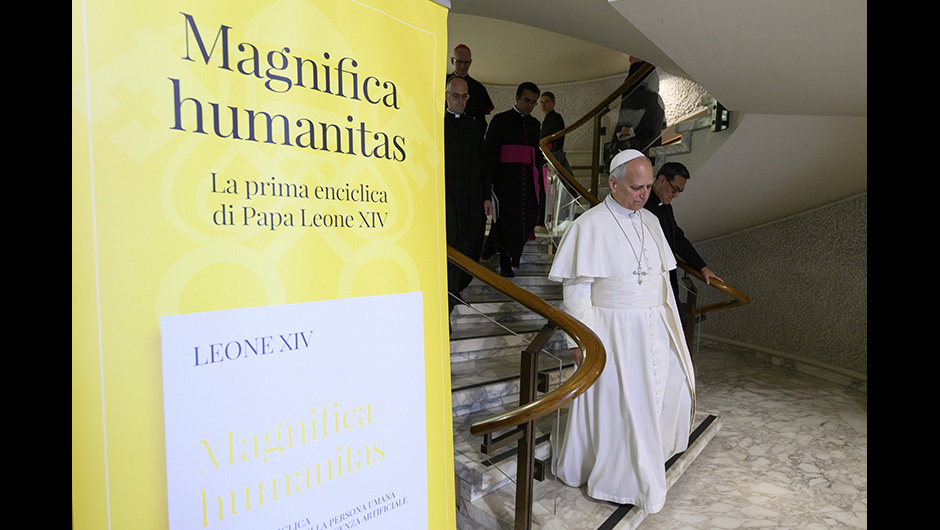
Catholic theologians and experts welcomed Pope Leo XIV’s first encyclical, “Magnifica Humanitas: On Safeguarding the Human Person in the Time of Artificial Intelligence,” for its defense of the “grandeur” of humanity and its insistence that technology be put at the service of people instead of the other way around.
The document, released on May 25, calls for AI to be “disarmed” and to be used to promote the common good and the dignity of all people, who were made in the image and likeness of God, said Passionist Father Enzo Del Brocco, president of Catholic Theological Union.
“At the center always is the human person, the human dignity, and that anything that happens in society, any progress that happens, the human person always has to be at the center,” Del Brocco said. “I think that the one unmistakable answer of the encyclical to the challenges of today is that artificial intelligence is neither humanity’s salvation nor its doom.”
But artificial intelligence opens new pitfalls for the understanding of the human person, and in “Magnifica Humanitas,” Pope Leo XIV confronts those by calling on the tradition of Catholic teaching, said Paula McQuade, a professor of English and Catholic studies at DePaul University.
“[‘Magnifica Humanitas’] recognizes in AI a fundamental challenge to religious and Catholic ideas of human personhood, specifically the dignity of human personhood,” McQuade said. “It argues, or it suggests, that AI is a symptom of, part and parcel of, what it calls a ‘technocratic paradigm.’ By that, it means it seeks to reduce human personhood to a being from which it can extract value, a being which can be controlled, and it seeks to value human personhood primarily for what it can offer.
“Against that, the church can draw on nearly two millennia of Catholic tradition on the dignity of human personhood. … We as human beings make decisions based on our emotions, our history, our creativity and our embodiment. All of those are key factors of human personhood, which are not addressed by AI.”
Father John Kartje, president and rector of the University of St. Mary of the Lake/Mundelein Seminary, agreed.
“What just strikes me as a really key piece that’s probably not going to be the kind of thing everybody thinks about when they say, ‘What are the ethical implications of AI?’ is that he gets to this very core of what it means to be human, and that, yes, our dignity is in the fact that we’re in the image and likeness of Christ,” said Kartje, who is also an astrophysicist.
If the philosophical challenge to traditional Christian ideas of human personhood is the first reason Pope Leo chose to address AI, the second is more practical. Proponents of AI have said the technology can take over much of the work now done by people, especially white collar workers, and it has been used on the battlefield, in selecting targets for bombing and other attacks.
“He foresees the societal disruption that will be caused by AI,” McQuade said. “Both in terms of people losing their jobs, but also leading increasingly online lives.”
Because of that, the presence of Chris Olah, cofounder of AI firm Anthropic, at the Vatican for the announcement of “Magnifica Humanitas,” was seen as significant. Olah welcomed the encyclical, saying the tech community needs “earnest, thoughtful critics” who “care about things going well and insist on safety, who are paying close attention, who are willing to say hard things.”
Pope Leo XIII, the namesake of the current pope, also addressed the dignity of human people and social and economic disruption in “Rerum Novarum” (“Of New Things”), published May 15, 1891, in the midst of the second industrial revolution. “Rerum Novarum” offered a foundation for much of Catholic social teaching, advocating for the dignity of work and of workers and for solidarity and subsidiarity, as it addressed “the rights and duties of capital and labor.”
Joe Vukov, associate director of the Hank Center for the Catholic Intellectual Heritage at Loyola University Chicago, said he was struck by the metaphor Pope Leo XIV used in the introduction to “Magnifica Humanitas,” contrasting the Tower of Babel with Nehemiah’s account of rebuilding the walls of Jerusalem.
The Tower of Babel was built, according to Genesis, because its builders wanted to be able to touch the sky and “make a name for ourselves” (Gn 11:4), and it ended in disaster and confusion, with people no longer able to communicate with one another.
The walls of Jerusalem, on the other hand, were rebuilt with much consideration and consultation, in an effort inspired by God, Vukov said.
“When we build the tower of Babel, we’re building something to our egos and trying to usurp God,” Vukov said. “But I think it’s really helpful to have this contrast with Nehemiah rebuilding the walls of Jerusalem. It’s a little bit of a deeper cut than the Tower of Babel. The Holy Father talks about building relationships before you even start laying the first stone. And what’s the end you’re building it to? A return to Jerusalem, and ultimately to the worship of God. … You get this contrast that isn’t a stark ‘yes’ or ‘no’ to AI and new technology, but rather, building is OK, technology is OK, development is OK. But we need to reflect carefully on the ends to which we’re building.”
That means that moral and ethical guidance has to come from a wider community than those who are simply seeking profits, experts said, and that is an area where the church has unique standing.
“This new tool or this new artificial intelligence, its progress has really been guided mostly by all private companies,” Del Brocco said. “There is a risk in my opinion today, especially with these big corporations who handle all this progress. Where is their main objective? Is it just profit? Or is it really for the growth of all humanity? Because the encyclical repeatedly reminds readers that the measure of progress is not just computational capacity, but the dignity of persons.”
That means that while AI, like other technologies, can be used for good or ill, it is not actually morally neutral, Del Brocco said.
“It’s never neutral because it reflects the values and the incentives and the power structures of those who build it and control it,” he said.
Both Del Brocco and Kartje found importance in Pope Leo’s discussion of human limitations.
While AI seeks to transcend human limitations, limitations are intrinsic to our nature, Kartje said.
“This will sound very grandiose, but what drives Christian spirituality is the fact that we are not God,” he said. “And so you have a Creator and a created. And to be created, from the moment of your conception, means you are limited. Almost everything we run into that gets in the way of our relationship with God is our rebelling against those limits in some way, shape or form.”
The difference between humans and AI is fundamental, Del Brocco said.
“We’ve just celebrated Pentecost, and artificial intelligence, you know, can never receive the Holy Spirit directly,” he said. “But we are bearers of God as humans. We possess something that is way, way, far beyond and far greater than any AI, data center, algorithm or android can ever be. We should never forget that.”
To read “Magnifica Humanitas,” visit vatican.va.